Showing posts with label sales. Show all posts

Wednesday, 10 June 2015

Affiliate Marketing Is Broken But Ecommerce Companies Can Adapt

Affiliate Marketing Is Broken But Ecommerce Companies Can Adapt

We’ve all heard digital marketers say, “You don’t need to sell advertising on your site, you can just take a percentage of a sale through affiliate marketing!"
While that may have rang true five years ago, affiliate marketing has changed dramatically — for the worse. Much of the action has now morphed into coupon affiliate sites like Coupon Craze and eBates. It boggles the mind why some of the biggest merchants in the world support these sites so wholeheartedly, because actually they’re paying them for sales they've already made.
The goal for all ecommerce marketers should be incremental sales growth, but that is hard to do when you’re paying twice for an incremental sale with these coupon affiliate sites.

What’s broken?

For the uninitiated: You know how when you’re checking out online, there’s always a field for a coupon code? Naturally, you’ve now learned to go online and search for coupons from the store. You might do it for shoes, electronics, or health products. (I do it for domain names.) You’re happy, because you saved money you otherwise would have spent.
If you’re the store owner, you see the predicament right away. There was a user who was about to purchase something at full price, and somehow they input a coupon code and cut in to your margin. Now you have to pay the affiliate site for something that they didn’t even refer, a commission to the broker, and offer a discount on the purchase. Ugh! It bums me out when I explain this to clients and see the dismay on their faces.

How affiliate marketing should work.

In a world where everything in affiliate marketing worked, a customer would be going on Coupon Craze to use it as a discovery platform. Today, it’s the opposite!
Sites like RetailMeNot say that they curate the best deals for their visitors, but they don’t. Affiliate sites should theoretically work likeGroupon and drive incremental sales, but Groupon and Teambuy’s deals don’t scale into actual customer acquisition. Consumers and merchants are also starting to feel “daily deal fatigue" as well.

Time to cut out the middle man.

Marketers have become dependant on affiliate brokers like Commission Junction (now CJ Affiliate), LinkShare (now the Rakuten Marketing Network), and eBay to handle their affiliate sales. Instead of depending on brokers, how about showing affiliate publishers’ sales by giving them limited access or even screenshots to your Analytics campaigns? In the past you would get access to amazing sites that could increase your incremental sales and get your name out there  by paying broker fees.
Times have changed. You won’t see any incremental sales today from paying brokers fees. I recommend directly calling the unique site or publisher you want for your partner. Make your own deal without going through a broker.

Reallocate your affiliate budget for your best marketing efforts.

By cutting out the affiliate, you get to play with more resources. Reallocate the money you were spending for affiliate marketing to proven customer acquisition channels wherever your sales are good, and some of it exploring new acquisition channels.
In the meantime, build your own coupon page and optimize those pages to drive search traffic. It might cut a bit into your margins, but at least you won’t unnecessarily pay an affiliate marketer. For example,Felt Noir has begun using coupon codes that have good SEO results without utilizing any affiliate networks (Disclosure: I'm a partner with Felt Noir on this initiative).
Affiliate marketing is more dismal by the day, but you can still develop incremental sales by working to become independent of the current system. You can create a robust sales funnel that isn’t reliant on third parties while everyone else continues following the leader, chasing smaller and smaller ROIs.

Monday, 1 June 2015

5 Big Internet Marketing Mistakes (That Are Incredibly Easy to Make)

5 Big Internet Marketing Mistakes (That Are Incredibly Easy to Make)

The Internet is full of “must-do” lists when it comes to web design and Internet marketing. Click through popular blogs, our own included, and you’ll find many different tips on what you have to try, use, or manage if you want to find customers over the Internet.
Knowing which mistakes to avoid is just as important as realizing which best practices you have to follow, however. For that reason, we’d like to point out five big Internet marketing mistakes that are incredibly easy to make:
1. Pestering your customers. Email marketing is incredibly valuable, but lots of companies use it to simply badger their customers week after week (or even several times per week) with one offer after another. Be sure to mix up your sales pitches with some informative articles and ideas, so your customers don’t feel like you’re just contacting them when you want something.
2. Sounding just like your competitors. A lot of business owners and managers are at a loss when it comes to describing or differentiating their companies, so they adopt the approach to either copy their competitors or come up with web content that is similar to what they’ve seen. The end result, though, is a set of pages that doesn’t set a business apart from the competition.
3. Promoting too many sales or discounts. When you’re constantly having sales and offering discounts, you don’t just give your business a short-term revenue boost – you also teach your customers that they can get your products or services for less if they are willing to wait long enough. In other words, discounting too much or too often can make it virtually impossible for you to find customers for your normal prices.
4. Not building trust. Today’s consumers have a lot of skepticism when it comes to what they read and see on the Internet. That’s why it’s up to you to do everything you can to build trust and credibility on your website. Show them that their transactions are safe, that you’ve been in business for a long time, and that other customers are willing to vouch for you. That brings us to…
5. Ignoring online reviews. The online reviews your company has are your most important marketing tool, because they essentially amount to word-of-mouth advertising. Do everything you can to encourage buyers to leave good reviews for your business, and take immediate action to clean things up if the feedback you get is less than stellar.
Are you working against your own Internet marketing success by making these common mistakes? If so, the first step is realizing that they’re holding you back and deciding to be smarter in the future. The second step is to call us today and let us show you how we can make your website more effective and profitable at the same time.

http://www.washingtontimesreporter.com/article/20150522/BLOGS/305229999/1662

Thursday, 9 April 2015

Everything You Need to Know About Attribution and Affiliate Marketing

affiliate markinh
This is a live blog post from AMDays in San Francisco.
Topic: Everything You Need to Know About Attribution and Affiliate Marketing.
Presenter: Todd Crawford (pictured above), Impact Radius

What is Attribution?

It’s understanding your data throughout the click path of your consumer buying cycle to understand what touch points and steps they took to complete a sale or final desired action and then assigning a value to each of these different actions.
It’s another way of getting insights into your data by analyzing the path your consumer took to buy.

Three Touch Points to Consider:

  1. Introducer (the first touch point)
  2. Assist (the middle touch point)
  3. Closer (the last click to purchase)

Common Attribution Models:

  • First click, Last Click
  • Fractional (Linear, Position, Time Decay)
It’s essential to not just look at your data, but understand what it means. Attribution is analysis.
Note: A lot of people actually don’t need attribution. If you only have a few channels and a few people managing it, it’s likely not necessary.  However, if you have many channels and many people managing it, attribution will help you understand the value of team and channel efforts and big picture results much more clearly.

What can Attribution Tell Us?

It answers the what, where, when and why of each of your ads and channels.

What Do We Want From Attribution?

  • Better results (lift, savings, higher ROAS etc.)
  • No surprises (money badly spent or results we didn’t want)
  • Eliminates chance
  • Incrementally

Why Haven’t We Mastered This Yet?

  • Intra-affiliate
  • Source of data
  • Missing pieces
  • Company politics

 Modeling Versus Analysis

Modeling gives us perspective. We have to look at the data critically and think about it to make sure the information we are looking at is actually accurate.
Ask the question, “What are the most common paths to conversion?”
Using multichannel, as an example, it might look like this:
Google SEM -> Direct -> Email -> Bing SEM -> Google SEM -> Email -> Direct -> Newsletter -> Ebates -> Facebook Ad -> Google SEO -> Google SEM -> Affiliate

How do we Leverage Attribution?

  • By having clear goals and KPIs that are most important to you and ensuring that’s set up correctly for accurate tracking.
  • Leverage your data.
  • Analysis
One of the value measurements to add to affiliate specifically is in the benefit of zero cost to zero conversion, versus the extremely high cost to zero conversion in other channels that require ad buys, such as the cost of zero conversion through Google paid search campaigns. Affiliate has no cost if the action doesn’t take place. That’s a huge benefit to affiliate, and should be weighed when adding value to that channel.

In Summary:

  • Attribution is inevitable if you have enough data and enough moving pieces to consider.
  • Data is your frenemy — the insights can provide both good and bad news.
  • You need to put in the effort to get the results!

Monday, 6 April 2015

What is Internet Marketing ?

Post Image

Welcome to the latest and most effective Internet Marketing Training Guide, designed to take you by the hand and walk you through the process of getting the most out of Internet Marketing on behalf of your business. I’m so excited to have you here, and I know this will be very helpful for you.
Chapter I: What is Internet Marketing all about?

Definition:

The Internet is a worldwide network that enables easy sharing of information among users scattered around the globe. The World Wide Web is a feature of the internet which provides services specifically for web sites.
Marketing is the methodology of communicating where businesses are associated with the buying and selling of products and services, and dealing with offerings that have some advantages for their clients, customers and society.
Internet marketing would then mean a cumulative amalgamation of both these modes of communication which facilitates info sharing with its users.

Internet Marketing is the process of ‘How to advertise products and services, and promote business or brand’ over the internet with a set of powerful tools and techniques.
This marketing strategy consists of having an extensive range of marketing aspects and mechanisms such as Email marketing, Social Media Marketing, Search Engine Optimization etc., instead of traditional marketing.
Technology is changing at a very rapid pace which makes it difficult for marketers to be on track with it. Therefore, they are seeking the help of the internet to evolve and adapt their marketing to the online sphere.
The growing dependence of businesses on the internet is not hidden from anyone. With the advent of globalization, people have access to numerous sources of information, which subsequently increases their purchasing power.
Powerful search houses like Google, Yahoo etc. have enabled people to search fast and easily to suit their requirements. You can make use of various types of promotion tactics like pay-per-click and banner ads to bring valuable visitors to your website.
  • The Purpose of internet marketing:
The basic purpose of internet marketing is to enable businesses to grow- both in terms of monetary gains and value addition to their products and services.
With effective use of internet marketing strategies, you can follow a pin-point plan of action and move ahead as per your desired targets.
Most of the business organizations have these basic objectives –
  • Money making:
Most of the businesses today have the basic objective of using internet marketing to gain monetary benefits. It’s good to be money oriented, but keep in mind not to lose track of your quality aspect in the long run.
  • Value delivery:
Value delivery aims to give customers the best quality at the most affordable prices.
This has been going on for ages in the business industry. Prolonged efforts have been made, and they have yielded expected results for the users.
  • Brand enhancement:
A cumulative effort of both the above points, it focuses on maximum customer satisfaction by providing them the best quality products at an affordable cost, also. Brand enhancement enables you to enhance customer base with reduced efforts.
  • Overall business success:
A careful and planned implementation of internet marketing strategies proves to be of immense help for your business. All the facets of growth are easily catered to if these strategies are given their due importance.
  • Educating the consumers:
Internet marketing helps a great deal in educating the consumers. By proper utilization of it, information sharing becomes convenient and gets transmitted across various channels.
  • Facilitates advertising process:
A company’s advertising process gets boosted with internet marketing. By making people aware of the products and services through internet marketing, businesses are cutting its cost on advertising in a big way.
  • Better communication:
Communication within an organization as well as with customers is facilitated with internet marketing. Through effective online promotions, large numbers of people get information in a short time.
  • How to get started with Internet Marketing:
Internet Marketing is a great method that will help you make big bucks with the latest technology, online power tools and low cost. The below mentioned points will enable you to get started with internet marketing in a simple manner –
  1. Set goals: Be attentive and have clearly defined goals. Find the answer of “Why.” This “Why” gives you a straightforward idea to decide clear objectives for your business and follow them in a smooth manner. It also enables you to move forward in a stream lined direction and avoid going off track for achieving your goals. (you’ll have clearly defined goals)
  2. Manage expectations: Do extensive research on your targeted customers, and their likes and dislikes. You should find out what their exact requirements are and give an apt solution for that. (That’s called need recognition)
  3. Set yourself up for success: You need to determine proper tools to manage your web presence. Distinctive views of every product and service will help you to get more traffic. You can try numerous ad copies to find the best ad copy for specific products and services to attract your potential customers.
  4. Have something worth selling: Give some great offers to capture your visitor’s attention. You can also print out your product and service benefits and why they should opt for your product instead of others.
  5. Get started: You are done with everything, such as setting up the goals, research, tools and products. Now, you can opt for sites or networks that you want to use or test to make your campaign successful. Be honest and realistic with your expectations because nothing is a magic bullet.

Monday, 30 March 2015

From Catwalks To Conversions: How Bloggers Become Successful Through Affiliate Marketing

Gone are the days of hopeful but helpless fashion lovers seeking partnerships with and recognition from the major labels. These days, contributor Adam Weiss says, advertisers are pulling out all of the stops.


Fashion Week in New York has come and gone, and once again, fashion bloggers took center stage. Recently, there has been growing interest in what drives the relationship between high-end fashion brands and the bloggers that write about them. How do they actually work together and why is this partnership growing increasingly significant?
The best fashion brands recognize the importance of these influencers by understanding the true value they bring. Bloggers at the top of their game contribute millions of dollars in new consumer revenue by simply mixing their personal style and personality with their ability to choose the right partners and host affiliate links for brands they love.
In fact, a recent study shows that 72% of millennials and 51% of Gen Xers follow fashion bloggers; more importantly, 90% of wealthy consumers who follow fashion bloggers make purchases as result of the blogs.
So how do bloggers get started in affiliate marketing, and what separates the top earners from the rest?

1. Choose The Right Network

Affiliate networks provide access to thousands of brands – including leading and emerging brands in a wide range of categories. They also provide the technology and tools to build relationships, create links, track results and pay out the publisher partners in their network. (Disclosure: the author’s company operates an affiliate network.)
Most bloggers just getting started in affiliate require support, training and strategic guidance; thus, it’s important to look for a network with educational programs and an easy-to-use interface with publisher-friendly tools creating a seamless experience to get links to the brands, retailers, or products that they want to link to.
The infrastructure and reliability of that network to support a high volume of clicks and transactions, monitor traffic and provide on-time payments are equally important. Most leading networks work on Cost Per Acquisition (CPA) which means bloggers are paid a percentage of each sale they drive for their brand partner. These percentages vary by partner and network, but can be very lucrative for bloggers driving the right traffic for the right brands.
Bloggers that collaborate directly with advertisers optimize the partnership with custom campaigns, increased commissions, and incentive to generate maximum exposure across all marketing channels, like social media. Therefore, it’s best to work with a network that grants the 1-1 relationship proven to generate the most revenue.

2. Choose The Right Partners

Successful bloggers understand the importance of working with brands that appeal to their audience and have the potential to create long-term, productive partnerships.
This brings up native advertising, which can be defined as advertising within the design of the publisher’s site – in this case, within the content. When a fashion blogger promotes an item or brand they actually wear or admire, takes a photo with the item or writes about how and where to purchase, the content falls into place naturally and reads true to their audience.
This works as the perfect match to drive sales. (Note that the blogger must provide appropriate disclosure to stay on the right side of the FTC.)
Affiliate marketing on content sites is one example of native advertising, but with nativead spend estimated to grow to $4.57 billion by 2017, the advertising ecosystem will be forced to evolve, and there is no doubt that bloggers will be more selective about the advertisers they work with. Commission potential is not the most important element – it’s marrying the product to the content.

3. Diversify Your Reach

Pinterest has recently made headlines with its announcement to remove all affiliate links from the site. This has been devastating to some bloggers, while others have been unaffected. How is that possible? In one word: diversification.
Bloggers shouldn’t rely too heavily on one content channel to drive sales. In fact, the most successful bloggers use a variety of social media and tools to share their images, content and affiliate links. The goal is to find the right media mix to interact with and attract new readers versus trying to build success from a single site.
Some bloggers utilize social media channels, like Twitter, to market site features and products mentioned within content. Because Instagram does not provide its users a solution to tag products featured in posts, third-party services allow bloggers to create “lookbooks” from their Instagram content. Because influencers utilize social media to expand their reach and their own personal brands, affiliate marketing tools are evolving to allow bloggers to monetize not only on their sites, but on social media.

4. Use Your Data To Make Smart Decisions

Just as brick-and-mortar stores rely on inventory management to determine orders and minimize costs, bloggers must rely on their data to determine where they’re selling, what they’re selling and which links convert better than others.
The data available to bloggers can give them a range of information including how to optimize their site to increase conversions, as well as a better look into what drives their visitors to purchase.
Consistent and reliable data and reporting are key to higher commissions and sales. Utilizing the data from an affiliate network allows bloggers to develop content based on what’s engaging their audience.

In Summary

The tides have certainly turned in the blogger’s favor. Gone are the days of hopeful but helpless fashion lovers seeking partnerships with and recognition from the major labels. These days, Advertisers are pulling out all of the stops to get their products in front of the major influencers on social media. Affiliate marketing provides the perfect introduction.
The lucrative partnership of brands and bloggers will only grow stronger. There is unlimited revenue potential for bloggers who make the right decisions and we will continue to see new, innovative ways to shop evolve as a result.

http://marketingland.com/catwalks-conversions-bloggers-become-successful-affiliate-marketing-121676

Friday, 20 March 2015

Using Online Marketing To Increase Offline Sales

Many brick-and-mortar companies are discovering the benefits of using online marketing to increase their offline sales. According to a study conducted by Forrester Research, nearly 92 percent of purchases take place offline following online consumer activity. The results of the study are backed up by results from studies conducted by Accenture, Yahoo, and comScore.
The mistaken believe that online marketing is solely for companies that have a large presence on the internet has hampered the ability of brick-and-mortar companies to take advantage of the results that online marketing offers to all businesses. Here are some ways that your business can use online marketing to increase offline sales.
Focus On Building Your Brand
Online marketing can be used to increase your online popularity to match your offline popularity. Do your research to find out what current customers love about your brand and incorporate that into your online marketing campaign.
You can distribute your marketing campaign content through various social media channels to reach a wide audience of individuals that may be interested in what your company has to offer. Strive to create compelling content that social media users will want to share with others, increasing your brand recognition for minimal costs.
Engage With Potential And Existing Customers
Many brick-and-mortar companies make the mistake of thinking that all they have to do is put their online marketing campaign content on the internet and the rest will fall into place.
Online marketing is about engaging with current and potential customers and companies that ignore this fact are going to miss out on sales.
Take time to connect with these people through Facebook messages, tweets on Twitter, and marketing emails to show that your company is interested in engaging with customers and increasing brand loyalty.
Use Online Marketing To Advertise In-Store Technology
In today’s increasingly tech-connected world, more people than ever are using technology to research and shop for the products they need. Your online marketing campaign should showcase any in-store technology used to enhance the customer’s experience to draw more people to your brick-and-mortar store.
If your store offers price matching from price comparison apps, include this in your marketing so that potential customers will be aware of the policy. The implementation of technology in your store can increase your sales by a considerable amount.

Tuesday, 17 February 2015

The EASY Way to Build an Email List Fast!

Are You Ready for Pinterest's Buy It Now Button


We All heard the news that No more Affiliate links will be allowed on Pinterest BUT dint expect it to turn into A Buy IT Now PIN…..


Move over, Pinning. Here comes buying.
Pinterest, the digital scrapbooking service, is laying the groundwork for an e-commerce offering with a “Buy” button that could launch in as little as three to six months, according to multiple sources. One of the people cautioned Pinterest may wait longer to roll it out, while another said the shopping feature would likely start as a limited test.
The Buy button would allow Pinterest users to order and pay for some of the products they discover on Pinterest without leaving the company’s website or app, these people said. Currently, Pinterest’s 70 million monthly visitors use the service to save and share images of things like recipes, furniture, food and clothing. But since Pinterest burst onto the scene several years ago, industry observers, analysts and users have been waiting for the day that it would transform itself from a digital corkboard into a digital mall.
The company has focused its near-term strategy on advertising, introducing Promoted Pins in May with a handful of big brands, and also recently introduced an “Install” buttonthat lets users download iPhone and iPad apps from within Pinterest. But a big part of what has excited some marketers about Pinterest is its potential to become a spectacular e-commerce platform. For example, it’s logical to assume people are signaling some interest — if not clear purchase intent — in a product when they Pin an image. By adding a Buy button, Pinterest is aiming to shrink the time between wanting something and buying it.
A spokeswoman for Pinterest* declined to comment on the company’s e-commerce strategy. Instead, the company responded: “Part of our strategy to help people discover new things, save them, and do these things in real life has always been to make Pins more useful.”
To handle the payments processing, Pinterest is close to an agreement with Stripe, a young payments company that has similar arrangements with Facebook and Twitter, according to industry sources. A Stripe spokeswoman declined to comment.
It’s not clear whether Pinterest’s advertising and commerce products will be integrated. But one could imagine a scenario in which retailers that incorporate Pinterest’s Buy button could also pay Pinterest to promote those images on the platform, similar to how some brands pay brick-and-mortar retailers to position their products more prominently than competitors’ in stores.
Pinterest’s e-commerce plans come as other social platforms such as Facebook and Twitter begin to experiment with their own Buy buttons. These tests, coupled with the rise of discovery-driven commerce apps such as Fancy, Wish and Wanelo, may have forced Pinterest’s hand in introducing a shopping function sooner than it had originally planned.
We All heard the News that Affiliate Links will be banned from Pinterest but are ready to start buying directly from Pinterest …..

Despite coming late to the game, Pinterest has an advantage over Facebook and Twitter because its users are already coming to the site to find new products. Its user base is also larger than any of the startup apps mentioned above. The challenge will be managing its users’ expectations, as it probably won’t hold any inventory of the products being sold. That means Pinterest won’t control the shipping process, which could make the shopping experience uneven for users. Pinterest will be counting on the sellers to do a good job with order fulfillment, while users may still blame Pinterest if something goes wrong.
The company will also find itself competing against Amazon, which has dabbled with Pinterest-like layouts in the past, as well as eBay, which has unabashedly taken cues from Pinterest’s grid format in its new homepage design and its iPad app. Then there’s Google, which is contemplating adding Buy buttons to some of the ads it shows next to search results, according to a recent report.
As the field has become more crowded, this was a plunge Pinterest had to take. Not only to live up to its hype and valuation — currently $5 billion after raising more than $750 million — but because the opportunity is too big to pass up. Last year, eMarketer estimated that the global e-commerce market would surpass $1.7 trillion in sales in 2015.


* Pinterest executive Joanne Bradford is an independent board member of Re/code’sparent company Revere Digital and has no involvement in our editorial process.

Sunday, 23 November 2014

15 Pinterest Tactics To Drive Sales and Traffic

Pinterest TacticsPinterest is where your prospects and customers turn to get inspiration and shop on social media; it’s couch commerce at its best.
Tweet This Pinterest has 30 billion pins and 750 million pinboards according to founder Evan Sharp. Yet the beauty of Pinterest is that users never feel overwhelmed.Pinterest focuses on the individual. Socializing happens as a result of shared interests, not personal relationships.
Pinterest users are highly active on other social media networks according to Global Web Index. As a result they don’t need the same input from family, friends and colleagues that they get from other social media platforms.  Pinterest users—Global Web Index-2014
For marketers Pinterest is ALL about sales and traffic. While it’s never anyone’s first choice for social media marketing, it delivers measurable results that you can’t ignore.Besides you’re hardly alone: 500,000 businesses are on Pinterest.


Pinterest’s guided search goes beyond “I want this information” to provide users with information about what other people are asking who look for the same thing. It informs the user based on other people. This can be helpful for businesses.


Pinterest has a 16% average global use rate based on 2014 Global Web Index data. A third of Americans have a Pinterest account. Further, women dominate Pinterest usage (and other Pinterest marketing trends.)


Pinterest drives sales

Pinterest has a $65 average order value, $10 higher than Facebook’s $55 average order value.  Further Pinterest exceeds Facebook and YouTube in its percentage of downstream traffic directed to retail sites according to Experian. The top retailers are Amazon, Target, Zulily, Walmart and Norstrom. 

Pinterest Tactics
Actionable Pinterest Tactics:
  • Know your audience’s Pinterest tastes. You have to know your target customers and what they seek on Pinterest. Include this information in your social media persona. Pinterest is where consumer conversations happen, especially food and fashion according to Shareaholic. Social Media Shares By Category-Shareaholic-2Q2014
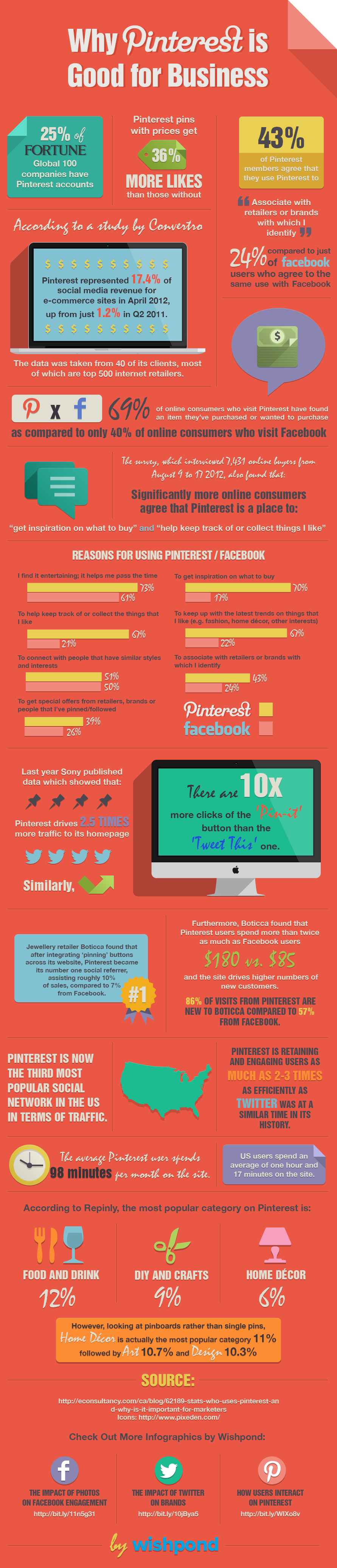
  • Include prices in your pins. Tweet This Pinterest pins with prices get 36% more likesaccording to Wishpond. Use rich pins to include current pricing details and directly link to your product page. This makes them more effective selling tools. Otherwise, the use has to hover over the pin for it to appear. (Here are more Pinterest tips for repinability.) Here’s how Target uses rich pins for pricing.Pinterest tactic -Pricing on rich pin
  • Use prices to alert pinners when the price drops on rich pins (Hat tip:GetElastic). Via email Pinterest notifies any user who pinned your product when the price drops, even you have no connection with the pinner. Further, for Gmail, the message is considered social, not a promotion.
  • Spotlight your popular product on Pinterest on your website. Target calls its page of pinned merchandise its awesome shop. Boutique shop ModCloth also does this. Underlying this recommendation is the fact that a highly pinned product acts like a rating that customers seek. Most popular pins-ModCloth
  • Re-imagine your older merchandise pages for product that’s no longer available. While you may no longer have the product, if it’s got pins, you may still receive purchase-oriented traffic. Take advantage ofthis opportunity by acknowledging that the product’s no longer in stock, then redirect them to similar product, the category page, your homepage, or ask them to opt-in to your email list.

Pinterest drives traffic

Pinterest is the second largest referrer of social traffic. It’s up 50% since last year according to Shareholic. In September, Pinterest delivered 5.52% of total visits sites received.
Buzzfeed is its poster child for social traffic. (To be clear, Buzzfeed gets most of its traffic from search. Facebook is the largest driver of social traffic to Buzzfeed.)
Actionable Pinterest Tactics:
  • Take a page from the Buzzfeed playbook. Create at least 1 pinboard for your blog posts and other content. Peg Fitzpatrick does this as well and confided that it’s a great driver of traffic. Add this to your content curator’s duties.(1) BuzzFeed on Pinterest
  • Skip the same old, same old when naming your Pinterest boards. When creating new pinboards, use keywords in the names. Don’t use undescriptive options like “My Style.” Note how Peg Fitzptrick does this. Peg Fitzpatrick on Pinterest
  • Attract traffic with other types of rich pins. They include: Place Pins (map, address, and phone number), Article Pins (headline, author and story description), Recipe Pins (ingredients, cooking times and serving information), and Movie Pins (ratings, cast members and reviews).
  • Choose your “About” section words with care. Include the full link back to your site and keywords in your 200 character limit. Remember Pinterest doesn’t like shortened links.
  • Crosslink to your other social media profiles. Let your followers get to know who you are and expand your reach across platforms.
  • Think traditional newspaper mechanicals. Put your best content above the fold to maximize visibility.
  • Maximize the power of your images. Use the right size photo in the right place. Profile image is 165 x 165 pixels, Board title 217 x 146 pixels, a standard pin is 238 pixels wide and an expanded pin is 736 pixels wide. Here are more details on Pinterest images and descriptions.
  • Use keywords in your image descriptions. While you can use up to 500 characters to describe each pin you upload, keep your explanation to about half of that amount to maximize repins. Of course, the same applies to your image descriptions on your website. For example, don’t use photo101.jpeg. Instead use girl.jpeg
  • Use your hashtags. As with other social media platforms use appropriate hashtags to broaden your reach but limit yourself to 3 or less hashtags per pin.
  • Add the “Pin It” button to encourage readers to share your content. Don’t forget to add a Pin It button to all of your merchandise pages. (BTW–We’d be thrilled if you pinned our charts on your pinboards!!!)

Pinterest goes mobile

75% of Pinterest shares occur via mobile, higher than Facebook based on Shareaholic. Social Media Shares-Via Mobile-Shareholic-2Q2014-1
  • 12% of Pinterest shares come via smartphone.
  • 22% of Pinterest shares come via tablet.
Users spend 2 hours and 18 minutes on Pinterest during an average month according toNielsen. Their time breaks out: 36 minutes via a computer, 1 hour 39 minutes via a mobile app and 3 minutes via a smartphone browser.
Actionable Pinterest Tactic:
  • Make your content mobile friendly to reach Pinners where they spend their time. Improve your mobile website and install rich pins.
The fact that you can put a price on Pinterest is a strong reason to give it a place of honor in your social media strategy. The fact that using rich pins sends an email to everyone who’s pinned your product is an amazing incentive that every marketer, especially B2C, should be scrambling to use.
Added to this, Pinterest drives traffic, regardless of what type of marketer you are. Therefore, make sure that your content curator is optimizing pins of your current and past content to attract more readers.
Since marketers use an average of 6 to 7 social media platforms, Pinterest must be in your social media and marketing plans for 2015 and beyond.